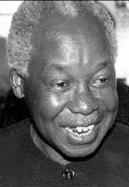
Julius Kambarage Burito Nyerere was born in 1922 at Butiama village,
Musoma, Tanzania. He was a Zanaki by tribe. His father was Chief Burito
Nyerere and his mother was Mgaya Wanyang'ombe. His father died while
Kambarage was still young. His mother who raised him died in 1997 at the
ripe old age of almost 100. Kambarage, the name he was given at birth,
means "the spirit which gives rain" in Zanaki because the day he was
born a very heavy rain fell.
In 1934 he was admitted to Mwetenge Primary School in Musoma, Tanzania, a school that was about forty-two kilometers from his home. Nyerere was a brilliant and hard working student. He regularly scored the highest marks in the class and was the leading pupil in all examinations. He received the highest score in the country on the standard four examination. After that he undertook studies at Tabora Government School in 1937, graduating in 1942.
When he reached the age of twenty, he decided to join the Roman Catholic Church. For the occasion he was asked to take a baptismal name so he chose the name Julius. He was baptized on December 23, 1943 by Father Mathias Koenen.
After passing the examination at Tabora quite successfully, he was able to begin studies at Makerere University in 1945. At the university, Nyerere liked to talk about politics, especially the politics of liberation. He also preferred traditional African dances to western forms of dance. He disapproved of drinking alcohol. Some of his fellow students thought that Julius Nyerere might become a priest later on because of this.
After Makerere University Nyerere took a position as a teacher at Saint Mary's School, owned by the Roman Catholic Church in Tabora.
Nyerere received a scholarship to go to Edinburgh University in Scotland where he studied history, politics, and economics. In addition, in his spare time he studied Greek and Latin. In 1952, he was the first Tanzanian to be awarded a Masters degree. When he returned to Tanzania he was assigned to work at St. Francis School, Pugu.
Nyerere married Maria Gabriel Majige, a primary school teacher, on January 24, 1953. Father William Collins officiated at their wedding.
In 1954 he started to get involved in politics and joined the political party called Tanganyika African Association (TAA). On July 7, 1954 the name of the party was changed to Tanganyika African National Union (TANU). At this meeting Nyerere was elected the first president of TANU. The Roman Catholic leadership in charge of St. Francis School at Pugu where he was teaching asked him to choose between teaching at their school and his work in politics. Consequently he decided to resign his teaching position and pursue politics.
He traveled throughout the country campaigning for independence (Uhuru in Swahili), continuing on even in the face of numerous threats and obstacles from the colonial government. In 1958 he went in front of the United Nations Organization (UNO) to plea for the independence of Tanganyika which was then under the ordinance of the British Trusteeship Territory. On December 9, 1961, Tanzania received its independence and Nyerere became the first prime minister of Tanganyika. After a few months, he resigned from his position in order to strengthen the party and Rashid Mfaume Kawawa became prime minister. On December 9, 1962, Nyerere was elected the first president of the Republic of Tanganyika. When Tanganyika and Zanzibar united to form the United Republic of Tanzania on April 26, 1964, Nyerere became the first president of Tanzania.
He introduced the political ideology of socialism and self-reliance so "that people…could live together and develop in dignity and freedom, receiving the full benefits of their cooperative endeavors." (Man and Development, p. 37)
Even as a politician, Nyerere practiced his Christian faith openly in concrete ways. First, he was a very devoted member of the Roman Catholic Church. When at home he went to early Morning Prayer everyday from 6.00 to 7.00 a.m. at St. Joseph's congregation, Dar es Salaam. Also, instead of fancy titles, he preferred to be called Mwalimu which means "teacher" in Swahili. Secondly, for the sake of religious tolerance he helped to formulate the religious articles in the constitution of the government of Tanzania and endorsed them in the 1960s. These articles, which are still used at the present time, mainly focus on the right to freedom of religion. The article on freedom of religion was re-incorporated in 1984, 1992, 1995, and 1997. Thirdly, Nyerere made many efforts to cultivate mutual relationships with religious leaders.
Fourthly, whenever he was invited to participate in church functions, he challenged churches to strive to fulfill their calling. Nyerere was a committed and professing Christian and church member and, as a result, he felt it was his responsibility as a politician to challenge the church to remember her responsibility to society. In one of the speeches he gave at the Maryknoll Sister's Conference in New York on October 16, 1970 (quoted from Man and Development, p. 48), he emphasized the church's role in society in these words:
As president of Tanzania from 1961 to 1985--and even afterwards--Nyerere continued to challenge the church until his demise in 1999. He often had the opportunity of speaking to church leaders and the laity and told them that the church had to serve the whole person, mentally, spiritually, and physically. Furthermore, he said that church had to serve people beyond the church. For instance, schools, hospitals, and income generating projects would not only benefit churches and Christians but also non-believers. This was a means of witnessing the Word of God to unbelievers.
In 1989 and 1993, as chairman of the ruling party called Chama Cha Mapinduzi (CCM or "Revolutionary Party") Nyerere led two seminars--one in Dodoma and one in Zanzibar--on family planning and the development of Tanzania, that were attended by party leaders, government leaders, and religious leaders--both Christian and Muslim.
For the well-being of individuals and the nation in general, Nyerere was committed to peace initiatives in Tanzania especially in the area of religious tolerance. Thanks to his wisdom, Tanzania has lived in a state of religious tolerance since independence in 1961 because of the foundation Nyerere laid, especially between Christians and Muslims. President of the United Republic of Tanzania, His Excellency Jakaya Mrisho Kikwete, affirmed this in a speech he gave at Boston University (U.S.A.) on September 25, 2006 entitled "Managing Religious Diversity in a Democratic Environment: The Tanzania Experience" in which he said,
Finally, Nyerere was well versed in his knowledge of the Bible and a good witness to his faith. He emphasized that the African socialism practiced in Tanzania necessarily included religion. A communistic and purely secular system would be against the interests of the country and would not work.
Nyerere resigned from the office of the presidency in 1985. Due to his reputation as a leader, the international community appointed him peacemaker for the Burundi conflicts. Later he was appointed mediator for the political problems in the Democratic Republic of Congo. He was also chairman of the South-South Commission. In his reconciliation efforts, Nyerere noted that the major causes of civil conflicts were poverty, greed for power, and tribalism.
Using his international influence, Nyerere launched a campaign for the cancellation of debts owed by poor countries. The campaign, which was continued by many other organizations worldwide, persuaded some rich countries to cancel the debts of developing countries.
Shortly before his demise, Nyerere predicted his death and promised to pray for the people of Tanzania, saying, "Najua sitapona toka ugonjwa huu. Nasikitika kuwaacha Watanzania wangu. Najua watalia sana. Lakini mimi nitawaombea mbele ya Mungu." ("I know that I shall not recover from this sickness. I am unhappy to leave my Tanzanians. I know that they will mourn very much. But I shall pray for them before God.") Indeed it was a very sad day for President Benjamin Mkapa, the cabinet, all of Tanzania, and friends of Tanzania worldwide, when Julius Kambarage Nyerere, "the father of the nation" died on October 14, 1999 at 10.30 a.m. at St. Thomas' hospital in London, United Kingdom.
His body was flown to Dar-es-Salaam, Tanzania on October 18, 1999 then taken to the national stadium in order to give the people an opportunity to bid him farewell. International representatives and presidents from many African nations, the United States, and Canada came to give their condolences to the nation of Tanzania for the death of Mwalimu Nyerere. Afterwards, his body was flown from Dar-es-Salaam to Butiama, his birth place, Musoma district, Tanzania on October 21, 1999 in the afternoon. On October 22 the people from Butiama village, Mara region, and the neighboring regions paid their respects to Mwalimu Nyerere. He was buried on October 23, 1999 in God's graveyard, belonging to Nyerere's family in Butiama village.
Nyerere was a great politician and African thinker as well as a philosopher. He left behind a widow, Maria J. Nyerere, and seven children. Their names are Rosemary, Anna, Madaraka, Makongoro, Andrew, John, and Majige.
Nyerere wrote many books and some of his speeches were compiled into books. Some of his works are After the Arusha Declaration (1967), Azimio la Arusha (The Arusha Declaration) [1976], Crusade for liberation (1978), Education for Self-Reliance (1967), Freedom and Development (1960), Man and Development (1974), Ujamaa--Essays on Socialism (1968 and 1971), Uongozi wetu na hatima ya Tanzania (Our leadership and the destiny of Tanzania) [1993]. Some of his books are used as university text books in Tanzania and beyond and some have been translated from Swahili into English, French, Portuguese, and Arabic. Nyerere also translated some books of the Bible into Zanaki. In 1996 he wrote poetry and spiritual songs inspired by the Gospels of Matthew, Mark, Luke, John, and the Acts of the Apostles.
In 2005 the Catholic Diocese of Musoma opened a cause for Nyerere's beatification. Tanzanian Catholics eagerly await the Vatican's final decision on the canonization of Mwalimu Julius Kambarage Nyerere, a devout Roman Catholic and first president of the United Republic of Tanzania.
Nyerere was a great historical figure not only in Tanzania but also in the rest of Africa and the world, having committed his life to attaining independence for his country--and supporting the efforts of other surrounding countries--to establishing peace and stability, and to developing economic and educational opportunities in Tanzania while preserving human rights and dignity. His Christian life as a political leader was exemplary. May God bless all the things he achieved for the well-being of mankind. [1] Angolwisye Isakwisa Malambugi
In 1934 he was admitted to Mwetenge Primary School in Musoma, Tanzania, a school that was about forty-two kilometers from his home. Nyerere was a brilliant and hard working student. He regularly scored the highest marks in the class and was the leading pupil in all examinations. He received the highest score in the country on the standard four examination. After that he undertook studies at Tabora Government School in 1937, graduating in 1942.
When he reached the age of twenty, he decided to join the Roman Catholic Church. For the occasion he was asked to take a baptismal name so he chose the name Julius. He was baptized on December 23, 1943 by Father Mathias Koenen.
After passing the examination at Tabora quite successfully, he was able to begin studies at Makerere University in 1945. At the university, Nyerere liked to talk about politics, especially the politics of liberation. He also preferred traditional African dances to western forms of dance. He disapproved of drinking alcohol. Some of his fellow students thought that Julius Nyerere might become a priest later on because of this.
After Makerere University Nyerere took a position as a teacher at Saint Mary's School, owned by the Roman Catholic Church in Tabora.
Nyerere received a scholarship to go to Edinburgh University in Scotland where he studied history, politics, and economics. In addition, in his spare time he studied Greek and Latin. In 1952, he was the first Tanzanian to be awarded a Masters degree. When he returned to Tanzania he was assigned to work at St. Francis School, Pugu.
Nyerere married Maria Gabriel Majige, a primary school teacher, on January 24, 1953. Father William Collins officiated at their wedding.
In 1954 he started to get involved in politics and joined the political party called Tanganyika African Association (TAA). On July 7, 1954 the name of the party was changed to Tanganyika African National Union (TANU). At this meeting Nyerere was elected the first president of TANU. The Roman Catholic leadership in charge of St. Francis School at Pugu where he was teaching asked him to choose between teaching at their school and his work in politics. Consequently he decided to resign his teaching position and pursue politics.
He traveled throughout the country campaigning for independence (Uhuru in Swahili), continuing on even in the face of numerous threats and obstacles from the colonial government. In 1958 he went in front of the United Nations Organization (UNO) to plea for the independence of Tanganyika which was then under the ordinance of the British Trusteeship Territory. On December 9, 1961, Tanzania received its independence and Nyerere became the first prime minister of Tanganyika. After a few months, he resigned from his position in order to strengthen the party and Rashid Mfaume Kawawa became prime minister. On December 9, 1962, Nyerere was elected the first president of the Republic of Tanganyika. When Tanganyika and Zanzibar united to form the United Republic of Tanzania on April 26, 1964, Nyerere became the first president of Tanzania.
He introduced the political ideology of socialism and self-reliance so "that people…could live together and develop in dignity and freedom, receiving the full benefits of their cooperative endeavors." (Man and Development, p. 37)
Even as a politician, Nyerere practiced his Christian faith openly in concrete ways. First, he was a very devoted member of the Roman Catholic Church. When at home he went to early Morning Prayer everyday from 6.00 to 7.00 a.m. at St. Joseph's congregation, Dar es Salaam. Also, instead of fancy titles, he preferred to be called Mwalimu which means "teacher" in Swahili. Secondly, for the sake of religious tolerance he helped to formulate the religious articles in the constitution of the government of Tanzania and endorsed them in the 1960s. These articles, which are still used at the present time, mainly focus on the right to freedom of religion. The article on freedom of religion was re-incorporated in 1984, 1992, 1995, and 1997. Thirdly, Nyerere made many efforts to cultivate mutual relationships with religious leaders.
Fourthly, whenever he was invited to participate in church functions, he challenged churches to strive to fulfill their calling. Nyerere was a committed and professing Christian and church member and, as a result, he felt it was his responsibility as a politician to challenge the church to remember her responsibility to society. In one of the speeches he gave at the Maryknoll Sister's Conference in New York on October 16, 1970 (quoted from Man and Development, p. 48), he emphasized the church's role in society in these words:
Poverty is not the real problem of the modern world. For we have the knowledge and resources which could enable us to overcome poverty. The real problem--the thing which causes misery, wars, and hatred among men--is the division of mankind into rich and poor. We can see this division at two levels. Within nation states there are a few individuals who have great wealth and whose wealth gives them great power, but the vast majority of the people suffer from varying degrees of poverty and deprivation. Even in a country like the United States of America, this division can be seen. In countries like India, Portugal, or Brazil, the contrast between the wealth of a few privileged individuals and the dire poverty of the masses is a crying scandal.Again, speaking on the unfair distribution of the world's resources, Nyerere stated:
…There are few wealthy nations that dominate the whole world economically--and therefore politically--and a mass of smaller and poor nations whose destiny, it appears, is to be dominated. The significance about this division between the rich and the poor is not simply that one man has more food than he can eat, more clothes than he can wear and more houses than he can live in, while others are hungry, unclad, and homeless. The significant thing about the division between rich and poor nations is not simply that one has the resources to provide comfort for all its citizens, and the other cannot provide basic services. The reality and depth of the problem arises because the man who is rich has the power over the lives of those who are poor, and the rich nation has power over the nations which are not rich. So the rich get richer and more powerful, while the poor get relatively poorer and less able to control their own future.What is the role of the church in such situations? Nyerere calls the church to recognize the need for a social revolution, and to play a leading role in it, "for it is the fact of history, that almost all successful social revolutions which have taken place in the world have been led by people who were themselves beneficiaries under the system they sought to replace" (Man and Development, p.98). He continues to say that,
(…) the church should join with these nations [Scandinavian countries and Canada] and if possible help to increase their number….Only by activities in these fields can the church justify its relevance in the modern world. For the purpose of the church is Man-- his human dignity and his right to develop himself in freedom. For all human institutions including the church, are established in order to serve man And it is the institution of the church, through its members which should be leading to attack on any organization, or any economic, social, or political structure which oppresses men, and which denies to them the right and power to live as the sons of a loving God.Finally, Nyerere concludes his speech to the Maryknoll Sisters by quoting from the Encyclical letter of His Holiness Pope Paul VI on the development of people, "If someone who has riches of this earth sees his brother in need and closes his heart to him, how does the love of God abide in him?" The pope then quoted St. Ambrose, "You are not making a gift of possessions to the poor person, you are handing over to him what is his." Later Nyerere quotes the letter again, saying, "To wage war on misery and struggle against injustice is to promote, along with improved conditions, the human and spiritual progress of all men, and therefore the common good of humanity. Peace cannot be limited to a mere absence of war; it is the result of an ever-precarious balance of forces. No, peace is something that is built up day after day, in the pursuit of an order intended by God, which implies a more perfect form of justice among men." (Man and Development, pp. 98-99)
As president of Tanzania from 1961 to 1985--and even afterwards--Nyerere continued to challenge the church until his demise in 1999. He often had the opportunity of speaking to church leaders and the laity and told them that the church had to serve the whole person, mentally, spiritually, and physically. Furthermore, he said that church had to serve people beyond the church. For instance, schools, hospitals, and income generating projects would not only benefit churches and Christians but also non-believers. This was a means of witnessing the Word of God to unbelievers.
In 1989 and 1993, as chairman of the ruling party called Chama Cha Mapinduzi (CCM or "Revolutionary Party") Nyerere led two seminars--one in Dodoma and one in Zanzibar--on family planning and the development of Tanzania, that were attended by party leaders, government leaders, and religious leaders--both Christian and Muslim.
For the well-being of individuals and the nation in general, Nyerere was committed to peace initiatives in Tanzania especially in the area of religious tolerance. Thanks to his wisdom, Tanzania has lived in a state of religious tolerance since independence in 1961 because of the foundation Nyerere laid, especially between Christians and Muslims. President of the United Republic of Tanzania, His Excellency Jakaya Mrisho Kikwete, affirmed this in a speech he gave at Boston University (U.S.A.) on September 25, 2006 entitled "Managing Religious Diversity in a Democratic Environment: The Tanzania Experience" in which he said,
The political unity and religious tolerance that we pride ourselves in did not come by accident. It is a product of deliberate action and the vision of leaders of Tanzania from the founding president, the late Mwalimu Julius Nyerere, to the present. (…) Thanks to the remarkable foresight of our founding president Mwalimu Julius Kambarage Nyerere, specific actions were taken to engender tolerance in matters of faith and manage potential cracks to our country. These categories can be classified into four categories: equitable policies, institutional innovations, political messages, and legal constitutional provisions.In his Boston University address, Kikwete expressed a very positive view of all that Nyerere had done to achieve equity in the educational sector for the sake of religious tolerance, saying, "Drastic as they may seem, these steps went a long way toward promoting and projecting the larger cause of national unity and social harmony which has become the hallmark of Tanzania today."
Nyerere realized very early on that equal access to education among Christians and Muslims would bring national unity and cohesion. Inversely, he recognized the potential dangers of religious discord resulting from imbalances in that area. Equal opportunities in matters of employment and participation in national affairs for Muslim and Christian Tanzanians were the direct result of equal education opportunities.
Soon after independence Nyerere initiated a legislation which was passed in 1962, compelling missionary schools to admit students of all denominations and faiths. In 1969 all non-state schools (the majority of which belonged to Christian missions) were taken over and made state schools. Seminaries were the only ones spared. (The Guardian, September 28, 2006).
Finally, Nyerere was well versed in his knowledge of the Bible and a good witness to his faith. He emphasized that the African socialism practiced in Tanzania necessarily included religion. A communistic and purely secular system would be against the interests of the country and would not work.
Nyerere resigned from the office of the presidency in 1985. Due to his reputation as a leader, the international community appointed him peacemaker for the Burundi conflicts. Later he was appointed mediator for the political problems in the Democratic Republic of Congo. He was also chairman of the South-South Commission. In his reconciliation efforts, Nyerere noted that the major causes of civil conflicts were poverty, greed for power, and tribalism.
Using his international influence, Nyerere launched a campaign for the cancellation of debts owed by poor countries. The campaign, which was continued by many other organizations worldwide, persuaded some rich countries to cancel the debts of developing countries.
Shortly before his demise, Nyerere predicted his death and promised to pray for the people of Tanzania, saying, "Najua sitapona toka ugonjwa huu. Nasikitika kuwaacha Watanzania wangu. Najua watalia sana. Lakini mimi nitawaombea mbele ya Mungu." ("I know that I shall not recover from this sickness. I am unhappy to leave my Tanzanians. I know that they will mourn very much. But I shall pray for them before God.") Indeed it was a very sad day for President Benjamin Mkapa, the cabinet, all of Tanzania, and friends of Tanzania worldwide, when Julius Kambarage Nyerere, "the father of the nation" died on October 14, 1999 at 10.30 a.m. at St. Thomas' hospital in London, United Kingdom.
His body was flown to Dar-es-Salaam, Tanzania on October 18, 1999 then taken to the national stadium in order to give the people an opportunity to bid him farewell. International representatives and presidents from many African nations, the United States, and Canada came to give their condolences to the nation of Tanzania for the death of Mwalimu Nyerere. Afterwards, his body was flown from Dar-es-Salaam to Butiama, his birth place, Musoma district, Tanzania on October 21, 1999 in the afternoon. On October 22 the people from Butiama village, Mara region, and the neighboring regions paid their respects to Mwalimu Nyerere. He was buried on October 23, 1999 in God's graveyard, belonging to Nyerere's family in Butiama village.
Nyerere was a great politician and African thinker as well as a philosopher. He left behind a widow, Maria J. Nyerere, and seven children. Their names are Rosemary, Anna, Madaraka, Makongoro, Andrew, John, and Majige.
Nyerere wrote many books and some of his speeches were compiled into books. Some of his works are After the Arusha Declaration (1967), Azimio la Arusha (The Arusha Declaration) [1976], Crusade for liberation (1978), Education for Self-Reliance (1967), Freedom and Development (1960), Man and Development (1974), Ujamaa--Essays on Socialism (1968 and 1971), Uongozi wetu na hatima ya Tanzania (Our leadership and the destiny of Tanzania) [1993]. Some of his books are used as university text books in Tanzania and beyond and some have been translated from Swahili into English, French, Portuguese, and Arabic. Nyerere also translated some books of the Bible into Zanaki. In 1996 he wrote poetry and spiritual songs inspired by the Gospels of Matthew, Mark, Luke, John, and the Acts of the Apostles.
In 2005 the Catholic Diocese of Musoma opened a cause for Nyerere's beatification. Tanzanian Catholics eagerly await the Vatican's final decision on the canonization of Mwalimu Julius Kambarage Nyerere, a devout Roman Catholic and first president of the United Republic of Tanzania.
Nyerere was a great historical figure not only in Tanzania but also in the rest of Africa and the world, having committed his life to attaining independence for his country--and supporting the efforts of other surrounding countries--to establishing peace and stability, and to developing economic and educational opportunities in Tanzania while preserving human rights and dignity. His Christian life as a political leader was exemplary. May God bless all the things he achieved for the well-being of mankind. [1] Angolwisye Isakwisa Malambugi